When attributing a contact to a specific source it is common to consider the first and lastest attribution. Both are always stored on every single contact.
First Attribution - is the first time a contact interacts with our system, when this happens we record attribution data for that session. For example: Someone fills out a Contact Us Form.
Latest Attribution - is the most recent recorded interaction with us, when this happens we record attribution data for this most recent session as well. For example: After filling out a Contact Us form they then decide to purchase our product via a Avantto Two-Step Order Form. When this happens, the latest attribution data will be recorded.
*The latest attribution will always change based on the last recorded interaction. However, the first attribution will not.
Now that we know what First and Latest Attribution is, we need to know where it is stored.
Rather it is the first or latest attribution data, you can locate this information in the bottom right of all contacts from the contact record.
Within the Account, go to Contacts > select a contact record > then locate the attribution data at the bottom right column under the activity tab.
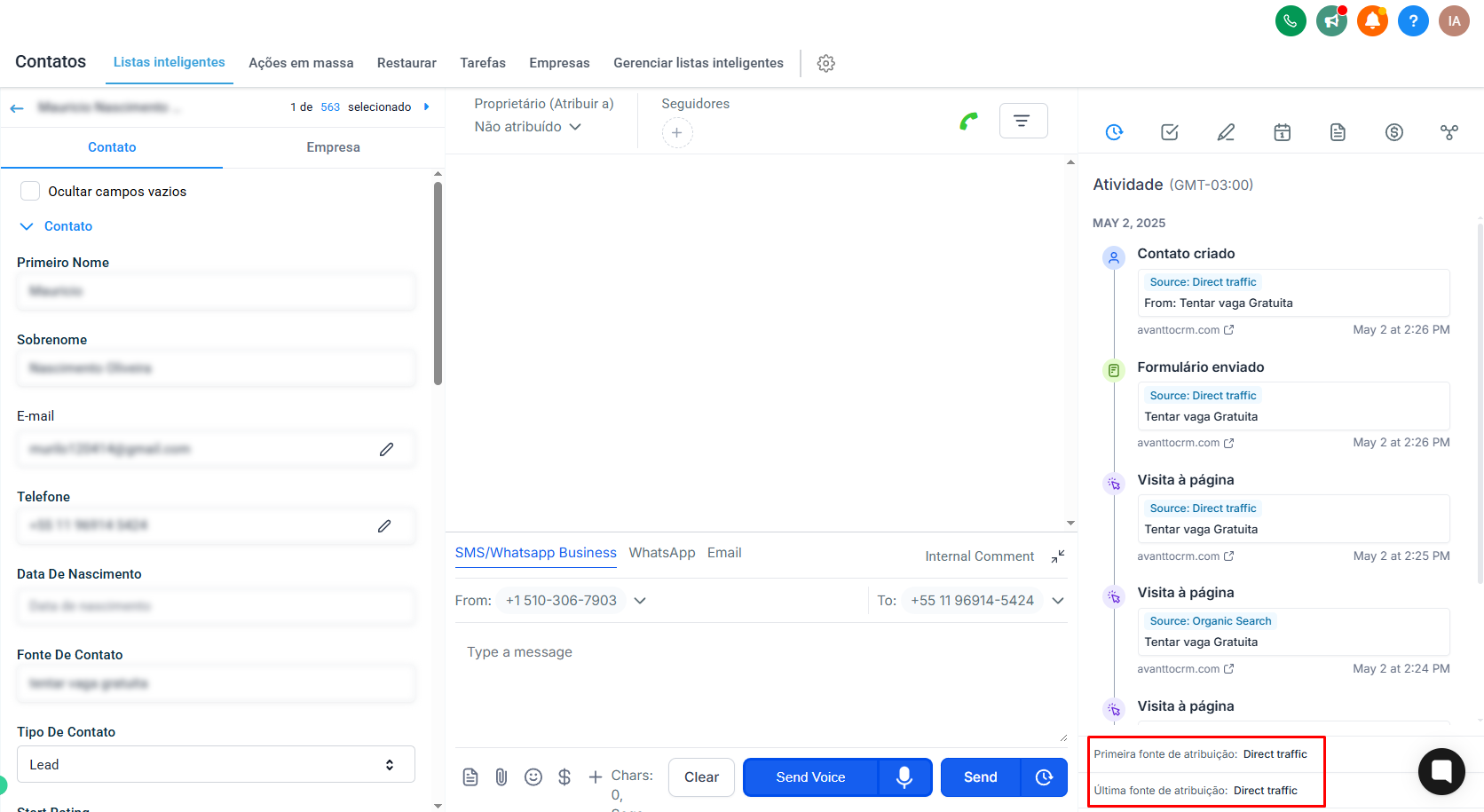
For contact creation, the first and latest attribution is defined as:

Below we will walk through each of the Attribution Sources you will see on the contact’s First Attribution or Latest Attribution value will be one of the following:
Paid Search
Paid Social
Direct Traffic
Organic Search
Social Media
Referrals
Others
CRM UI
Third-Party

Traffic categorized under Paid search comes from paid search campaigns (e.g., Google AdWords). This will help in analyzing the Google Ad Reporting.
It needs to have the UTM parameters matching (It is case-sensitive)
{YourLandingPageUrl.com}?utm_source=adwords&utm_medium={adname}&utm_campaign={campaignname}&utm_content={adgroupname}&utm_keyword={keyword}&utm_matchtype={matchtype}&campaign_id={campaignid}&ad_group_id={adgroupid}&ad_id={creative}
Google Ads UTM Parameters
Name | Key | Value |
UTM Source | utm_source | adwords |
UTM Medium | utm_medium | {adname} |
Campaign | utm_campaign | {campaignname} |
UTM Content | utm_content | {adgroupname} |
Match Type | utm_matchtype | {matchtype} |
Campaign | campaign_id | {adgroupid} |
Ad Group ID | ad_group_id | {adgroupid} |
Ad ID | ad_id | {creative} |
Traffic categorized under Paid social comes from a paid social campaign. This will help in analyzing the Facebook Ad Reporting if the leads are coming from Facebook
It needs to have the UTM parameters matching (It is case-sensitive)
{YourLandingPageUrl.com}?utm_source=fb_ad&utm_medium={{adset.name}}&utm_campaign={{campaign.name}}&utm_content={{ad.name}}&campaign_id={{campaign.id}}
Facebook and Instagram Ads UTM Parameters
Name | Key | Value |
UTM Source | utm_source | fb_ad |
UTM Medium | utm_medium | {{adset.name}} |
Campaign | utm_campaign | {{campaign.name}} |
UTM Content | utm_content | {{ad.name}} |
Campaign | campaign_id | {{campaign.id}} |
Traffic categorized under Direct traffic does not have an indication of its source (See row 8 above). Typically, these people typed the URL directly in their browser or removed all query parameters before entering a site.
To view the source URLs for these visitors, click the Direct traffic source.

Traffic categorized under Organic Search comes from non-paid search results in known search engines, such as Google, Bing, Yahoo, and Duckduckgo.
To view the keywords used in the search engine, click the Organic search source in the Sources table.
When there are Unknown keywords (SSL), it is likely due to the search engine encrypting user data. For example, Google encrypts all the search terms entered by their users.
Traffic categorized under Organic social comes from social media websites or apps. An example is when a visitor shares your content or website on their social media account, and their followers visit your content or visit the links inside your messages on social media.
Traffic categorized under Referrals comes from external sites that link to your website. It should not be a search engine or social media site. A referring domain may have multiple pages that link to your site.
When a lead is generated through various channels such as incoming calls, SMS, emails, WhatsApp messages, or Facebook messages, it is important to display all the information in one place. This helps keep track of all the leads and ensures that none fall through the cracks. By having a centralized system to manage all the leads, businesses can ensure they are not missing out on potential customers.
When a lead is created manually through the Avantto App CRM, its source is defined as this. This categorization helps in identifying leads that were created manually within the Avantto App CRM only.
When a lead is created by a third-party tool like Zap, its source is defined as this. This categorization helps identify leads created through third-party integration.
Within the same session, a contact must do one or more of the following actions:
Form/Survey Submission
Calendar Booking Submission
Chat Widget (After Submitting Contact Info)
Order Form Submission (One or Two-Step)
When you want to understand why a contact attribution source was added by Avantto to the contact, you need to understand what we look for when determining attribution data.
All attribution events follow a set of rules to categorize traffic into a specific source, and we check the full page URL and the referring domain, if available, against these rules.
They are applied in this order:
Order | Rule | Source |
1 | The "utm_source" parameter contains the word “adwords” for Google Ad. | Paid Search |
2 | The "gclid", "wbraid" or "gbraid" parameter is present, as they are Google click IDs. The "msclkid" parameter is present, it is the Microsoft click ID for Bing/Yahoo | Paid Search |
3 | The "utm_source", "utm_medium", or "utm_campaign" parameter is present and the referring domain is google.com. | Paid Search |
4 | The "utm_source" parameter contains the word “fb_ad” for Facebook Ad. We have deprecated utm_source=facebook, please use "fb_ad". The "utm_source" parameter contains the word “linkedin_ad” for Linkedin Ads, "twitter_ad" for Twitter Ads and "reddit_ad" for Reddit. | Paid Social |
5 | The referring domain is a social media site. | Social Media |
6 | Referring domain is a search engine. (Google, Yahoo, Bing, Duckduckgo) | Organic Search |
7 | Referring domain is not a social media site or search engine. | Referral |
8 | No referring domain or tracking URL. | Direct Traffic |
9 | This shows up if the lead came from an Incoming Call/SMS/Email/WhatsApp/Facebook message or any other source not covered above. | Others |
10 | Lead is manually created within the CRM system | CRM UI |
11 | Lead is generated from a third-party integration tool like Zap | Third-Party |
Now that we can see how Avantto chooses to apply a specific attribution source, let's walk through each attribution source together.